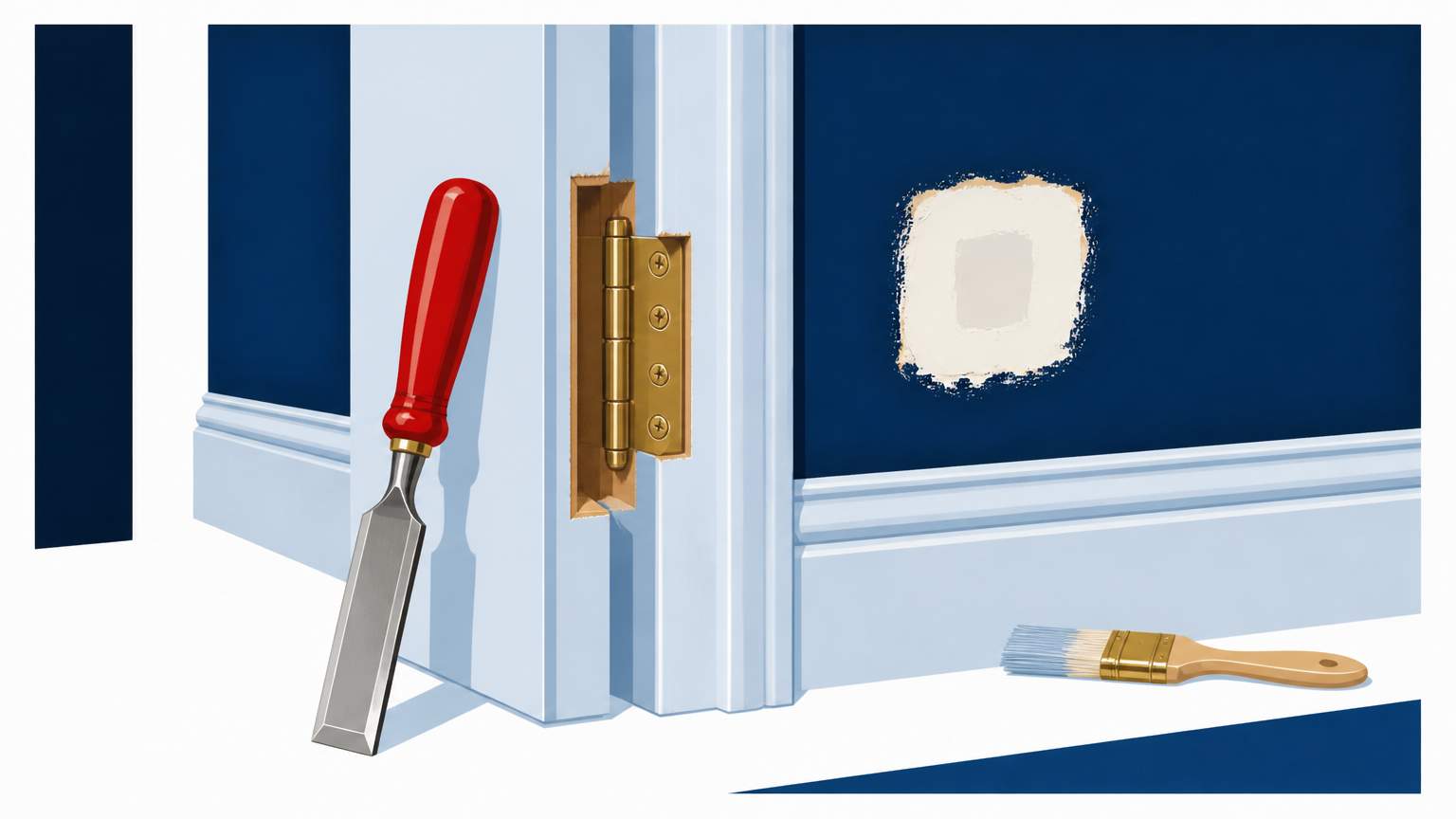
A crooked door can often be attributed to a hinge pocket that’s been poorly mortised. This mismatch can lead to friction and squeaks. If you live in Florida and want to avoid costly tools while still achieving a good result, you can use a chisel to create the hinge pocket. This process will keep the door aligned.
The first step is to find where the hinge back will go on the door or jamb and mark the hinge leaf thickness. Use a combination square with only a quarter-inch blade exposed to create a line that matches the thickness. To help with the depth of the mortise, you can wrap a thin strip of masking tape around the chisel, marking a reference point. These two steps ensure you’ll get a clean mortise.
Yes, it is possible to achieve a professional fit with this method. Start by lightly tapping the flat side of the chisel along the hinge outline to make a shallow groove. For rounded corners, score them with a utility knife without removing the tape. Work to remove a series of incremental cuts, likely a quarter-inch deep, while holding the chisel at a 45-degree angle. Strike with a hammer gently, which will keep the wood fibers intact and reduce the risk of splitting.
Once you’ve made the perimeter groove, clear the center by working the chisel from the center outward with the bevel down. A wider chisel, often a one-inch or larger bevel-up tool, should be angled slightly to flatten the pocket bottom. You can then fit the hinge leaf into the mortise and remove a little more if it doesn't sit flush. A sharp, flat-back chisel ensures the best results.
The most common reason why mortises split is that too much material is removed at once. If you take smaller increments of a quarter-inch, you can actually control the wood fibers better and avoid tearing. Another mistake is cutting too close to the edge grain; work from the center out, and the edge grain will be compressed and less likely to tear. A dull chisel can also be problematic because it forces you to work harder. A sharp chisel will give you a clean mortise and a smooth bottom.
The right mortise keeps the door aligned and lays the groundwork for related tasks like door trim installation or door window molding replacement. A flush pocket means the surrounding trim will sit evenly, eliminating gaps that need shimming and extra work. A well-aligned hinge also keeps the door from squeaking, something many homeowners notice after a storm or a new door goes in.
If the door is very thin or damaged, or if it needs a deeper mortise than the typical quarter-inch increments, it's better to call a licensed carpenter or a general contractor. While the chisel technique works for most interior door repairs, a professional can assess any structural concerns and ensure proper operation.
By marking the hinge leaf and using a masking tape depth guide, making incremental cuts, and finishing with a flat chisel, Florida homeowners can create a clean, quiet hinge pocket without needing a router or jig. The finished product is a door that swings smoothly, trim that’s even, and a project that saves money.
.svg)
.svg)

.svg)
